


Get the latest by subscribing to our blog
Among ancient lava fields, the Hantan river carves a winding path as it flows south along the Korean peninsula. The river’s water mingles with wetlands and basalt rock formations, enabling a uniquely diverse assortment of wildlife to flourish. For thousands of years, the fertile land has been home to a population of striped field mice, in whose veins a deadly virus has taken root1, 2.
It’s unclear when the hantavirus first reached the banks of the Hantan river, but it has since become endemic among the rodents that reside there. Had the virus stayed in its murine hosts, its presence would likely have remained innocuous. But in June of 1951, as soldiers in the Korean war began to camp in the river basin, the virus made a leap. Soldiers began to show up at medical tents with a mysterious hemorrhagic fever, one characterized by bleeding in the kidneys and easy bruising. By the end of the year, more than 1,000 patients had been identified, with thousands more to come by the end of the war. Roughly 15 – 20% of those infected succumbed to their illness 3–5.
Nearly 30 years later, samples collected from the basin’s striped mice population helped connect the mysterious illness to the previously unknown hantavirus 6. Once virologists knew what to look for, however, the virus’ footprint could be seen in historical outbreaks across the Eurasian continent 4. Retrospective studies showed that the Korean outbreak was far from the first time the virus had leapt into humans, and it wouldn’t be the last 7.
In April of 2026, a species of hantavirus known as the Andes virus (named for its prevalence in regions near the Andes mountains) jumped into a human host8. Likely unaware of the infection brewing within, the virus’ new host boarded a cruise ship to make a transatlantic journey from Argentina to Cape Verde. Unlike the other 30+ species in the orthohantavirus genus, the Andes virus is the only one of its kind that’s capable of spreading from human to human. By the end of May, 13 passengers aboard the ship had become infected, three of which died 8.
🦠 Quick Facts about the Orthohantavirus genus
There are more than 30 hantaviral species that fall under the orthohantavirus genus, almost all of which circulate within species-specific rodent reservoirs 7,9. While each is unique, they share many characteristics:
Genomic structure 1
- Hantaviruses are enveloped, segmented, negative-strand RNA viruses.
- Three segments—small (S), medium (M), and large (L)— make up their genomes, encoding for a nucleoprotein, two envelope glycoproteins, and an RNA polymerase, respectively.
- While similar enough for potential cross reactivity in serological assays, there is considerable divergence at the amino acid level among species, with an average divergence of 26% for the S segment, 29% for the M segment, and 23% for the L segment.
Pathogenic effects 5, 7, 9, 10, 11
- Within their host, hantaviruses typically infect the cells that line blood vessels, skin cells, and various immune cell types.
- Hantaviruses are informally split into Old World and New World groups.
- Old World hantaviruses are primarily found on the Eurasian continent and are associated with renal hemorrhagic fever (Korean Hemorrhagic Fever Renal Syndrome), often affecting mortality rates of 5–7%.
- New World hantaviruses evolved on the American continents and are associated with severe pulmonary inflammation (Hantavirus Pulmonary Syndrome). Mortality rates may be as high as 50–60%.
- Orthohantavirus andesense circulates within populations of long-tailed pygmy rice rats (Oligoryzomys longicaudatus) in South America and is the only known hantavirus capable of human-to-human transmission.
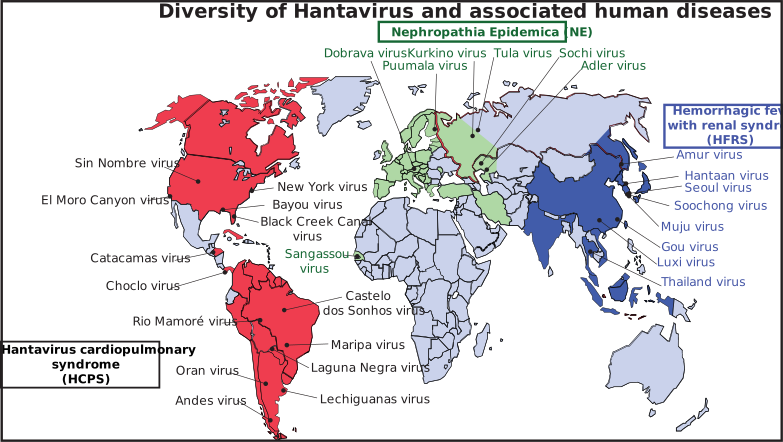 Figure 1: Distribution of hantaviruses. Annotated map of hantavirus distribution across the globe, with their associated human diseases. Image credit ViralZone https://viralzone.expasy.org/11849.
With the threat of human-to-human transmission and a high mortality rate, the remaining 100+ passengers were sent to quarantine in their home countries. Of those passengers, 18 were sent to the University of Nebraska Medical Center (UNMC) to stay in the National Quarantine Unit (NQU), the United States’ only federally funded quarantine facility.
While en route, the infection status of these 18 passengers was unknown. NQU staff would have to test them upon arrival, and it was Emily McCutchen’s job to make sure that could happen. As the deputy director of the National Public Health Laboratory at UNMC, McCutchen was tasked with designing an assay to detect the Andes virus in patient samples. Conceptually, the task was simple. In practice, it seemed impossible: She had to design the assay, gather an assortment of custom reagents, and perform validation studies according to legally mandated requirements. Such work would normally take weeks to complete. McCutchen had 72 hours.
Read our latest Case Study “Genes, Planes, and Automobiles: How the Nebraska Public Health Lab Developed a Hantavirus Assay in 72 hours” to learn how McCutchen’s team—with help from the global public health community and Twist Bioscience—was able to successfully develop and validate an Andes virus assay in under 72 hours.
References
- Bennett SN, Se Hun Gu, Hae Min Kang, Arai S, Yanagihara R. Reconstructing the evolutionary origins and phylogeography of hantaviruses. Trends in Microbiology. 2014;22(8):473-482. doi:10.1016/j.tim.2014.04.0082.
- Kim YR, Kim HR, Kim JY, et al. Spatio-temporal genetic structure of the striped field mouse (Apodemus agrarius) populations inhabiting national parks in South Korea: Implications for conservation and management of protected areas. Frontiers in Ecology and Evolution. 2023;11. doi:10.3389/fevo.2023.10380583.
- Rouabhia R, Dinh DT, Kua SC, Washington MA. Lessons Learned From the U.S. Military Experience With Hantavirus During the Korean War. Military Medicine. Published online September 13, 2022. doi:10.1093/milmed/usac2554.
- Mustonen J, Heikki Henttonen, Antti Vaheri. Hantavirus Infections among Military Forces. Military Medicine. 2023;189(3-4):551-555. doi:10.1093/milmed/usad2615.
- Noh JY, Jung J, Song JW. Hemorrhagic Fever with Renal Syndrome. Infection & Chemotherapy. 2019;51(4):405. doi:10.3947/ic.2019.51.4.4056.
- Lee HW, Lee PW, Johnson KM. Isolation of the Etiologic Agent of Korean Hemorrhagic Fever. Journal of Infectious Diseases. 1978;137(3):298-308. doi:10.1093/infdis/137.3.2987.
- Jonsson CB, Figueiredo LTM, Vapalahti O. A Global Perspective on Hantavirus Ecology, Epidemiology, and Disease. Clinical Microbiology Reviews. 2010;23(2):412-441. doi:10.1128/cmr.00062-098.
- Hantavirus Outbreak Linked to Cruise Ship Travel, Mulit-Locations. Who.int. 2026. Accessed October 7, 2026. https://www.who.int/emergencies/disease-outbreak-news/item/2026-DON6119.
- Laenen L, Vergote V, Calisher CH, et al. Hantaviridae: Current Classification and Future Perspectives. Viruses. 2019;11(9):788. doi:10.3390/v1109078810.
- Padula PJ, Edelstein A, Miguel SDL, López NM, Rossi CM, Rabinovich RD. Hantavirus Pulmonary Syndrome Outbreak in Argentina: Molecular Evidence for Person-to-Person Transmission of Andes Virus. Virology. 1998;241(2):323-330. doi:10.1006/viro.1997.897611.
- The virus that rocked the Four Corners reemerges | American Association for the Advancement of Science (AAAS). American Association for the Advancement of Science (AAAS). 2026. Accessed October 7, 2026. https://www.aaas.org/membership/scientia/virus-rocked-four-corners-reemerges
Recommended Resources

Twist Bioscience HQ
681 Gateway Blvd
South San Francisco, CA 94080