



 Genes
Genes
 Oligo Pools
 NGS
NGS
 Variant Libraries
 Antibodies
 IVDR Solutions






The Twist Alliance Panels are designed to give you a head start, bringing together expertise from multiple disciplines for superior target enrichment, for applications ranging from cancer diagnostics to ancient DNA analysis. If none of the panels look quite right for your needs, each panel can be customized with spike-in coverage where you need it. Of course, you can also build a completely custom target enrichment panel to fit whatever application.
Accelerate your assay development with our content from the Experts.
Gene fusions often act as oncogenic driver mutations in various cancer types. Their rapid and accurate detection can inform clinical actions and drive treatment decisions. The Twist Alliance CeGaT RNA Fusion Panel Kit is an RNA-based enrichment panel and offers an improved targeted and sensitive approach to investigate gene fusions than the conventional methods.
This panel includes 160 fusion genes associated with approximately 30 cancer types. CeGaT, a leading genetic diagnostic and sequencing company located in Europe, selected the fusion genes. The design not only detects known gene fusions but is also used to identify novel gene fusions.
The panel is optimized and validated for use with the Twist RNA Library Prep Kit for a complete end-to-end workflow with exceptional performance. High capture efficiency with the RNA-based enrichment increases the sensitivity of detection. This panel is ideal for screening oncology samples to inform treatment options or discover novel fusions for tumor classifications.*
Confidently Enrich RNA Gene Fusions
- Expert content design through collaboration with CeGaT
- Optimized workflow with Twist RNA Library Prep kit
- Twist core enrichment technology maximizes capture efficiency
Panel Design
- 160 fusion-associated genes with 66 genes in the breakpoint design
- 7,394 Probes
- Covers a variety of different cancer types
Long Read Sequencing Panels
Enables sequencing of genes that are difficult or impossible to fully sequence with short-read technology.
Targets 389 genes (20 Mb)
Key targets include GBA, SMN1/2
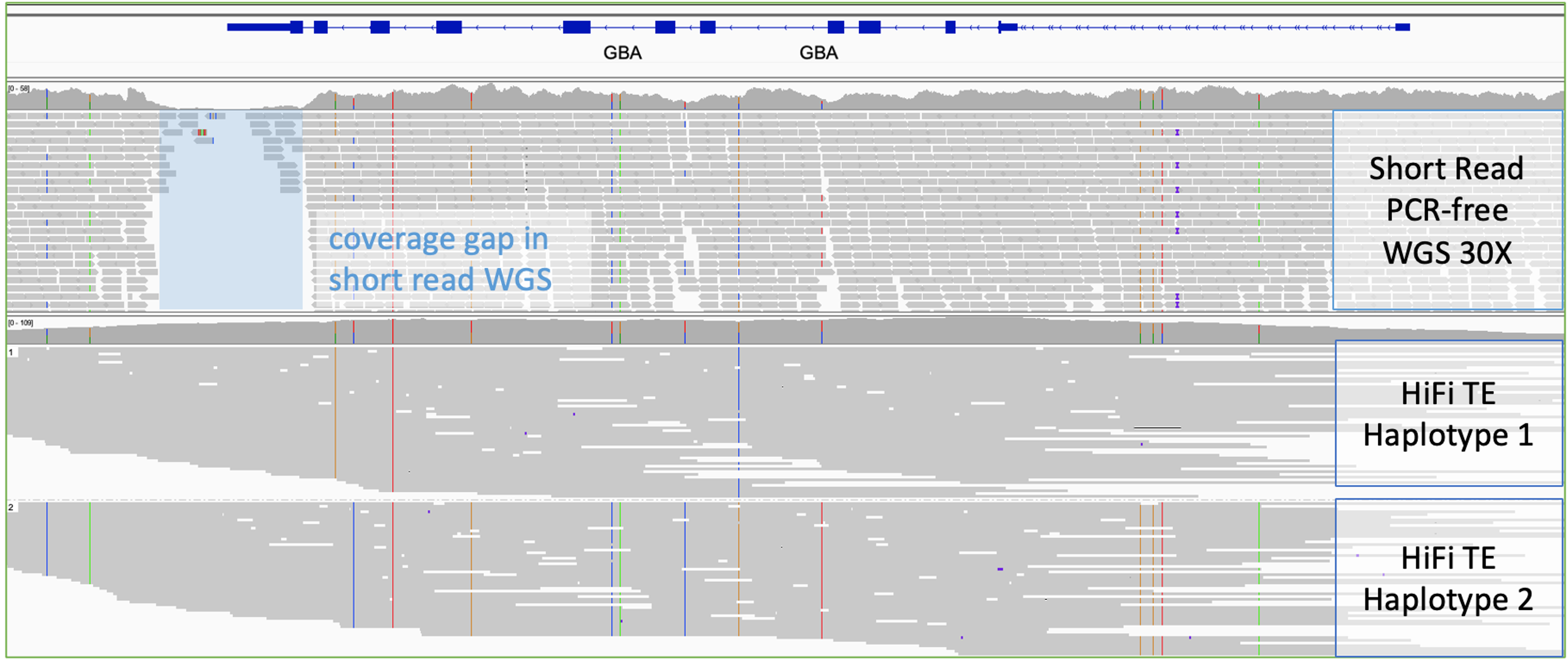
Full-gene phasing and no coverage gap in the GBA gene
Ordering Information
106747 Twist Alliance Dark Genes Panel, 2 Reaction Kit
106748 Twist Alliance Dark Genes Panel, 12 Reaction Kit
106914 Twist Alliance Dark Genes Panel, 96 Reaction Kit
Focus on important genes in pharmacogenomics that are critical to drug metabolism and patient therapeutic response.
- Targets 49 genes (2 Mb)
- Key targets include CYP2D6, HLA-A, HLA-B
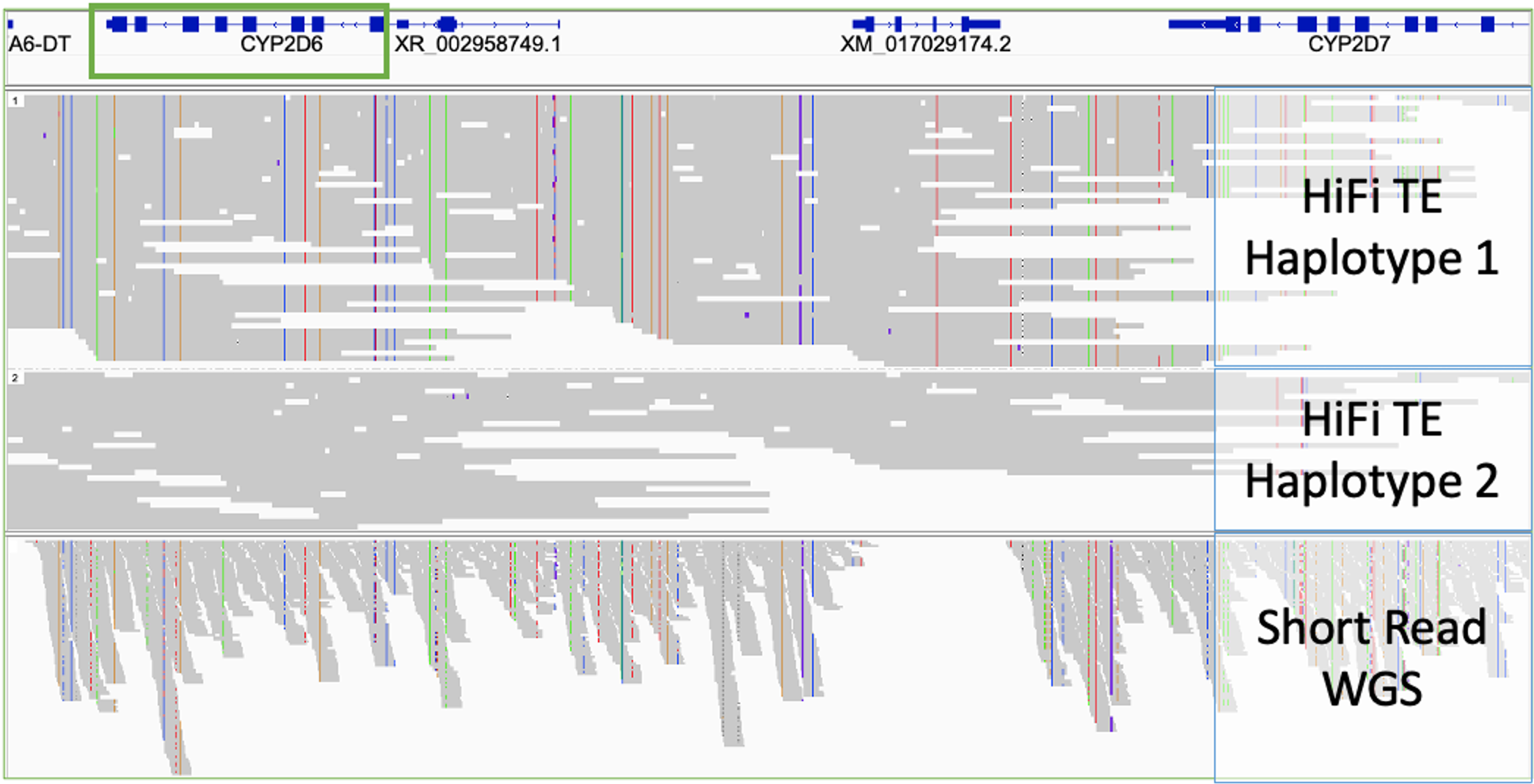
Accurate star allele calling at CYP2D6
Ordering Information
106749 Twist Alliance Long-Read PGx Panel, 2 Reaction Kit
106750 Twist Alliance Long-Read PGx Panel, 12 Reaction Kit
106915 Twist Alliance Long-Read PGx Panel, 96 Reaction Kit
Methylation Analysis Panels
Methylation sequencing is a sensitive tool for detecting and tracing the origin of cancer cells. But like any sequencing project, there is a tradeoff between breadth and depth of coverage. If you’re ready to focus on cancer-specific methylation patterns, this is the panel for you. Experts at AnchorDx partnered with Twist to create a custom target enrichment panel focused on methylation targets relevant to 31 different cancers.
The Twist Alliance Pan-cancer Methylation Panel - 1.5 MB provides deep coverage of clinically focused targets that allow for the study of methylation patterns that may be relevant to early cancer detection and diagnosis from tumor and liquid biopsy samples. Designed in collaboration with experts at AnchorDx and constructed using Twist’s world-class oligonucleotide synthesis platform, this panel provides a high on-target rate, high uniformity, and has been validated with the Twist Methylation workflow using liquid biopsy samples of breast cancer, colorectal cancer, and non-small cell lung cancer.
Interested in seeing which genes are covered? Contact us at customersupport@twistbioscience.com
Panel Design
31 cancer types, 47 disease entities, based on TCGA database
13,090 Probes
126,000 CpG sites involved
~12,000 Differentially Methylated Regions (DMRs)
9,000 of 12,000 (74%) overlapped with the CpG islands
Resources
Twist Alliance Pan-cancer Methylation Panel Resource Files
Ordering Information
104694 Twist Alliance Pan-cancer Methylation Panel - 1.5 MB, 2 Reactions
104695 Twist Alliance Pan-cancer Methylation Panel - 1.5 MB, 12 Reactions
104696 Twist Alliance Pan-cancer Methylation Panel - 1.5 MB, 96 Reactions
Twist Methylation Workflow:
101976 NEBNext® EM-seq™ Kit for Twist Targeted Methylation Sequencing, 96 Samples*
103557 Twist Methylation Enhancer, 12 Reactions
100578 Twist Universal Blocker, 12 Reactions
100983 Twist Binding and Purification Beads Kit, 12 Reactions
101174 Twist Fast Hybridization and Wash Kit, 12 Reactions
103496 Twist Targeted Methylation Sequencing Workflow, 96x12 Reactions
*2 reaction and 12 reaction sizes are also available for enrichment
DNA Analysis Panels
The Ancient Human DNA Panel was developed in collaboration with David Reich’s lab at Harvard University for use in studying the genetic variation in ancient DNA specimens, typically extracted from bones and teeth. The panel targets 1.35 million SNPs, which includes as a subset all of the 1.23 million polymorphic sites in the human genome which were originally published in Fu et al. Nature 2015 ensuring compatibility of new data generated using the Twist Human Ancient DNA Panel with published data on many thousands of ancient individuals. This panel enables genome-scale data at significantly reduced sequencing costs compared with shotgun sequencing due to the ability to highly enrich human DNA fragments.
This original panel was optimized using Twist’s double stranded capture probes and hybridization capture reagents resulting in high genome coverage and reduced allelic bias as seen in Rohland, Mallick et al. Genome Research 2022, PMID: 36517229.
For recommendations on assay set-up, please contact Twist Customer Support.
Ordering Information
Twist Alliance Ancient Human DNA Panel
107479 Twist Alliance Ancient Human DNA Panel - 13 Mb, 12 reactions
106658 Twist Alliance Ancient Human DNA Panel - 13 Mb, 96 reactions
104562 Twist High Concentration Mitochondrial Panel, 96 reactions
For Research Use Only. Not for use in diagnostic procedures
Understanding the genetic variation between dog breeds is critical to understanding genetic regulation of traits as well as the basis and progression of disease in dogs. Consequently, comprehensive gene panels such as exomes are pivotal in improving veterinary diagnostics and the associated clinical medicine. These types of NGS panels will also accelerate research into developing a deeper understanding of canine cancers and potential therapeutics.
The Twist Alliance Canine Exome developed in collaboration with the Broad Institute’s Karlsson lab provides just the right tool for canine genomic research. In addition, canine genomic research has also been found to have benefits for human medical research due to genetic similarities found between human and canine tumors such as CNVs, differential gene expressions, and structural chromosome abnormalities1.
The Twist Alliance Canine exome panel was designed with the following objectives in mind
- Covers coding exons of canine genes
- Enable comparative genomic studies between canine and human genomes
- Includes regions of known importance in human cancers
- Allows for cost-effective deep sequencing
- The panel contains more than 17k Genes/targets based on CanFam3.1, with additional coverage of genes/targets that are implicated in canine cancer.
The panel contains gene targets along with COSMIC mutations associated with each of these genes as detailed in McDonald et al.2- these genes were tiled 2x for higher coverage. FOXA1 and TERT promoter were tiled at 4x. All other regions were tiled at 1x, as per our standard practices.
With curated content from the leading canine cancer researchers in the world combined with Twist's robust panel performance, the Twist Alliance Canine Exome provides the most optimal tool for researchers studying canine diseases as well as rare human diseases.
1 Overgaard,N.H.,Fan,T.M.,Schachtschneider,K.M.,Principe,D.R.,Schook,L.B.,& Jungersen, G. (2018). Of Mice, Dogs, Pigs, and Men: Choosing the Appropriate Model for Immuno-Oncology Research. ILAR journal, 59(3), 247–262.
2 McDonald, J.T., Kritharis, A., Beheshti A., Pilichowska M., 4, Burgess K., Luisel Ricks-Santi L., McNiel E., London C.B., Ravi D., 2, Andrew M Evens A.M., (2018) Comparative oncology DNA sequencing of canine T cell lymphoma via human hotspot panel. Oncotarget 9(32), 22693–22702
Ordering Information
105305 Twist Alliance Canine Exome - 40.5 Mb, 2 Reactions, Kit
105306 Twist Alliance Canine Exome - 40.5 Mb, 12 Reactions, Kit
105307 Twist Alliance Canine Exome - 40.5 Mb, 96 Reactions, Kit
A prevalent issue with historical genotyping tools is their bias toward a small number of ethnicities, leaving significant portions of humanity underrepresented in classic genotyping workflows. As an example, microarray platforms only offer fixed content updated occasionally, compounding this challenge.
Researchers can solve these inefficiencies and inequities by utilizing target capture-based NGS workflows with probe panels designed for diversity and flexibility.
As part of Twist’s growing Targeted GBS portfolio, the Twist Diversity SNP Panel gives researchers a new flexible ethnicity-neutral gold standard to use for GBS.
Scientists have the freedom to use the panel as a stand-alone genotyping panel or as a spike-in into the Twist Human Comprehensive Exome panel. Its design is also customizable—additional probes covering regions of interest can be synthesized on Twist's DNA synthesis platform.
The Twist Diversity SNP Panel content was curated in partnership with leaders at the Regeneron Genetics Center. Designed to integrate into existing fully automated exome processing workflows, this panel provides base calls and imputed variants.
Genotype imputations can be calculated using open-source tools available. Please reach out to Customer Support to get a copy of our imputation guide to getting started with imputation analysis tools.
Note: The Diversity SNP panel content has not been fully validated through the complete Twist workflow. For recommendations on assay set-up, please contact Twist Customer Support.
PROBES: 640k
- SNPs COVERED: 1.4M
- SENSITIVITY: Imputation of most variants down to MAF of 0.1% or less
Resources
Application note: Capture-based SNP Genotyping with Twist Target Enrichment Panels
Ordering Information
104374 Twist Diversity SNP Panel, 2 Reactions
104375 Twist Diversity SNP Panel, 12 Reactions
104376 Twist Diversity SNP Panel, 96 Reactions
104393 Twist Diversity SNP Panel, 16 samples complete kit with Standard Hyb
104394 Twist Diversity SNP Panel, 96 samples complete kit with Standard Hyb
Where routine testing has failed to provide a diagnosis, physicians often turn to DNA sequencing panels for answers, particularly when a heritable disease is suspected.
Drawing on decades of experience in clinical genomics, Victorian Clinical Genetics Services (VCGS) has partnered with Twist to design an updated diagnostic panel—Twist Alliance VCGS Exome v2 - 39.9 MB—that covers the whole exome, with dedicated coverage boosting over clinically relevant genes (Mendeliome). In designing this panel, special care was given to ensuring additional coverage of clinically relevant loci that fall outside the gene coding regions traditionally targeted by exomes (i.e. known pathogenic loci in non-coding regions). Finally this panel also incorporates a backbone of probes covering SNPs in intergenetic regions at approximately 25 kb intervals to inprove copy number variation (CNV) calling.
The Twist Alliance VCGS Exome - 39.9 MB panel is a, highly uniform panel that can help streamline the identification of heritable disease-linked alleles, be it through carrier screening or pre- and post-natal testing.
- Total probes 528K
- Includes the Twist Exome 2.0 of 427.K probes
- and content curated by VCGS of 101K probes
Ordering Information
111124 Twist Alliance VCGS Exome v2 - 40.1 MB, 2 Reactions Kit
111126 Twist Alliance VCGS Exome v2 - 40.1 MB, 12 Reactions Kit
111150 Twist Alliance VCGS Exome v2 - 40.1 MB, 96 Reactions Kit
Resources:
[.bed Files] Twist Alliance Clinical Research Exome - 34.9 MB
The Twist Alliance Clinical Research Exome helps support the Broad Institute Genomics Platform and was designed using validated data from clinical patient samples. The panel leverages Twist’s flexible NGS platform to customize content easily and quickly, resulting in a comprehensive survey of the exome with supplemental enrichment of clinically relevant areas of the genome related to cancer as well as rare and inherited diseases. By leveraging the high uniformity of Twist NGS probes, the assay enables a per sample cost and throughput efficiency that Broad has already leveraged to process more than 250,000 samples, keeping it on the leading edge of exome sequencing.
The full design of this panel includes the Twist Core exome, the mitochondrial genome, and additional validated coding and non-exonic regions of interest such as the ACMG73 genes, supplemental coverage of regions from OMIM and COSMIC, and specific Broad-defined targets.
Ordering Information
104032 Twist Alliance Clinical Research Exome - 34.9 MB, 2 Reactions Kit
104033 Twist Alliance Clinical Research Exome - 34.9 MB, 12 Reactions Kit
104034 Twist Alliance Clinical Research Exome - 34.9 MB, 96 Reactions Kit
Resources
The Twist Alliance CNTG Hereditary Oncology Panel includes 72 selected cancer-associated genes and covers ≥99.5% of targeted regions. The panel can be used to identify genetic predisposition to hereditary tumors including breast cancer, gastrointestinal tumors, Li-Fraumeni syndrome, MEN1, MEN2, paragangliomas and others.
Ordering Information
105493 Twist Alliance CNTG Hereditary Oncology Panel- 0.2MB, 2 Rxn Kit
105494 Twist Alliance CNTG Hereditary Oncology Panel- 0.2MB, 12 Rxn Kit
105495 Twist Alliance CNTG Hereditary Oncology Panel- 0.2MB, 96 Rxn Kit
The Twist Alliance CNTG Rare Disease Panel includes more than 2,500 relevant rare disease-associated genes and covers ≥99.5% of targeted regions, offering researchers a more lightweight tool for capturing the crucial rare disease coverage in the CNTG Exome without the full footprint. This panel can be used to detect genes associated with but not limited to rare treatable diseases, early onset childhood disorders, cardiac disorders, neurodegenerative diseases, skeletal abnormalities, and metabolic disorders.
Twist Alliance Centogene Rare Disease Panel 78.8k probes
Ordering Information
105466 Twist Alliance CNTG Rare Disease Panel-7.6MB, 2 Reactions
105467 Twist Alliance CNTG Rare Disease Panel-7.6MB, 12 Reactions
105468 Twist Alliance CNTG Rare Disease Panel-7.6MB, 96 Reactions
Diagnosis of rare diseases presents many challenges for physicians and can lead patients on a long diagnostic odyssey. DNA sequencing panels can provide physicians answers to these challenges and resolution for patients. As a leader in rare disease diagnostics, CENTOGENE has partnered with Twist to design a series of target enrichment capture panels, providing comprehensive tools to aid in rare disease and hereditary oncology diagnosis.
The Twist Alliance CNTG Exome - 41 MB provides highly uniform coverage of the entire exome as well as full coverage of the mitochondrial genome. Combining insights from CENTOGENE’s bio/databank with exceptional omics technology, the Twist Alliance CNTG Exome - 41 MB increases diagnostic yield compared to standard whole exome sequencing and covers a broad spectrum of disorders encompassing >7,000 rare diseases.
Panel Information
- Total Probes 483k
- Twist Human Comprehensive Exome 396.1k
- Twist Mitochondrial Panel 139
- Twist Alliance Centogene Rare Disease Panel 78.8k
- Centogene Spike-In 7.8k
Ordering Information
105459 Twist Alliance CNTG Exome - 41 MB, 2 Reactions
105461 Twist Alliance CNTG Exome - 41 MB, 12 Reactions
105462 Twist Alliance CNTG Exome - 41 MB, 96 Reactions

Twist Bioscience HQ
681 Gateway Blvd
South San Francisco, CA 94080