



 Genes
Genes Oligo Pools
 NGS
NGS Variant Libraries
 Synthetic Controls
 Antibody Discovery
 IVDR Solutions


Twist Bioscience HQ
681 Gateway Blvd
South San Francisco, CA 94080
Building systems for generating potent, de novo antibodies using autonomous hypermutation and surface display in yeast
PRODUCTS USED
ABSTRACT
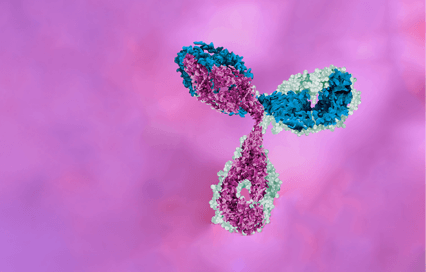
Conventional methods for generating high-affinity antibodies present numerous issues. For example, animal immunization is powerful, but can be inaccessible, slow, and incompatible with many antigens. Other methods such as phage display rely heavily on time-consuming, labor-intensive steps that limit speed and scalability. Here, I describe ‘autonomous hypermutation yeast surface display’ (AHEAD), a system that synthetically emulates the process of somatic hypermutation using highly engineered yeast cells to generate potent antibody fragments called nanobodies. Nanobodies are continuously diversified in vivo by encoding them on an orthogonally replicating error-prone plasmid. All the while, surface display of said nanobodies allows for enrichment for improved binding affinity through FACS sorting of cells bound with varying amounts of fluorescently labeled antigen. I describe the discovery of several high-affinity nanobodies for SARS-CoV-2 spike protein receptor binding domain (RBD) using AHEAD. Later in this work, I further increased the utility of this system by implementing various technical improvements and integrating a 1.8 x 10⁸ member nanobody library onto AHEAD. This allowed AHEAD to be useful not only as a method of affinity-maturing existing nanobodies, but also as a method of isolating an initial pool of de novo binders to then xii immediately and seamlessly evolve further. I describe herein the construction of this AHEAD library followed by its use to generate potent de novo nanobodies that bind to four diverse antigen targets: CD3e, IL-17F, coxsackievirus A6 (CVA6) VP1, and SARS-CoV-2 RBD. These nanobodies possessed on-yeast EC50 values ranging as low as 460 picomolar, demonstrating that I had constructed an accessible one-stop-shop for generating potent binders for a wide range of target antigens, with applications spanning drug discovery, diagnostics, and general biological research.