



 Genes
Genes
 Oligo Pools
 NGS
NGS
 Variant Libraries
 Antibodies
 IVDR Solutions








Twist Bioscience HQ
681 Gateway Blvd
South San Francisco, CA 94080
General
Close
- Do I need to include restriction sites or overhangs on my sequences?
- Does Twist meet biosecurity screening requirements for the United States?
- How are the genes delivered?
- How do I find out the arrangement of my genes in your 96-well plate?
- How does Twist test the quality of the gene synthesis?
- How is processing different when my gene is delivered in a plate versus having it delivered in a tube?
- How much of my DNA is delivered?
- How should I resuspend my genes?
- I got my genes, but the yield says “NA”. What does that mean?
- What is Animal Origin Free?
- What is the difference between Twist's Clonal Genes and Gene Fragments?
- What is the maximum size gene I can purchase?
- What is the minimum size gene I can purchase?
- What is the shelf life of Gene Fragments and Clonal Genes?
- What is the Target Yield option?
- What is the Turn Around Time (TAT) for gene synthesis?
- Where can I find an SDS for gene products?
Do I need to include restriction sites or overhangs on my sequences?
For Gene Fragments (either with or without adapters), you may wish to add your own restriction sites onto the ends of each fragment in order to easily clone the fragment into your vector of choice.
For Clonal Genes, simply submit the unique insert sequences that you would like us to clone into the vector backbone. We use a proprietary homology-based cloning method to assemble our clonal genes and we design and add the homologous overhang sequences for you - you do not need to consider our cloning strategy when designing your insert.
Please note that our Cloning vectors do not have restriction sites directly flanking the insert. This allows for complete flexibility of design so that you can append the desired restriction sites onto the flanks of your insert for use in your downstream workflow.
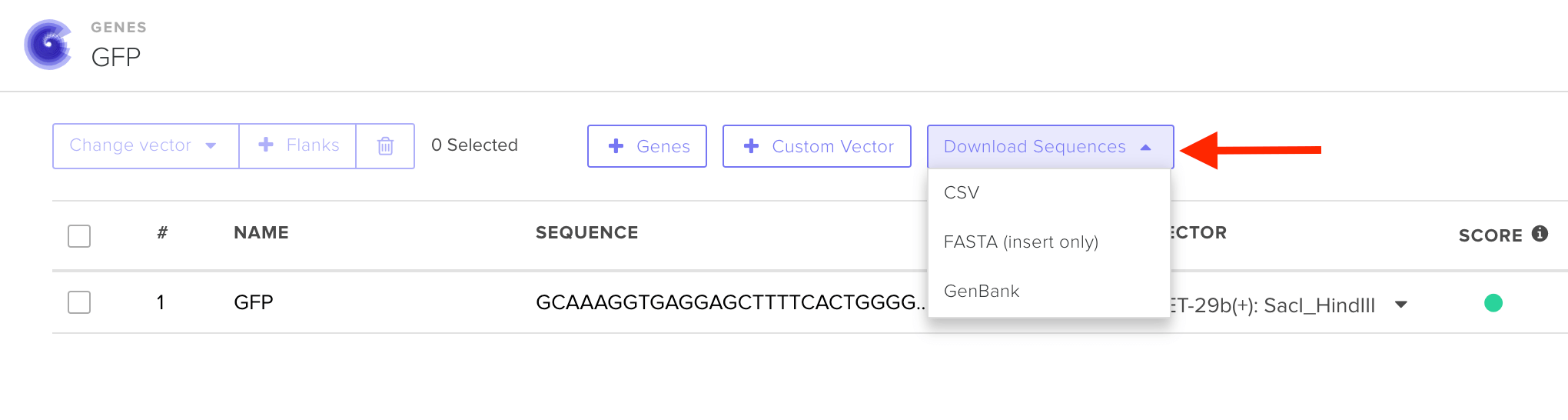
Our Expression vector insertion points are denoted by two restriction sites - these will be fully preserved directly flanking your insert in the final construct. We recommend that customers check the final construct sequences by clicking on the "Download sequences" button in the designer. Once an order has been submitted for manufacturing, it cannot be altered in any way.
Still have questions? Contact Us
Does Twist meet biosecurity screening requirements for the United States?
Twist Bioscience attests that the company adheres to all requirements in the U.S. Office of Science and Technology Policy (OSTP) Framework for Nucleic Acid Synthesis Screening. Download the attestation here.
Still have questions? Contact Us
How are the genes delivered?
Gene products are typically delivered as a dried-down product (unless otherwise specified).
Clonal Genes are delivered cloned into one Twist's catalog vectors or your own custom vector. Gene Fragments are delivered as linear, double stranded sequences (with or without flanking adapters).
We deliver the gene sequences in 96/384-well plates. For small orders (less than 10), the genes can be delivered in tubes at no additional cost. For orders with 10 or more genes, tube order requests are an additional $50 per order.
Still have questions? Contact Us
How do I find out the arrangement of my genes in your 96-well plate?
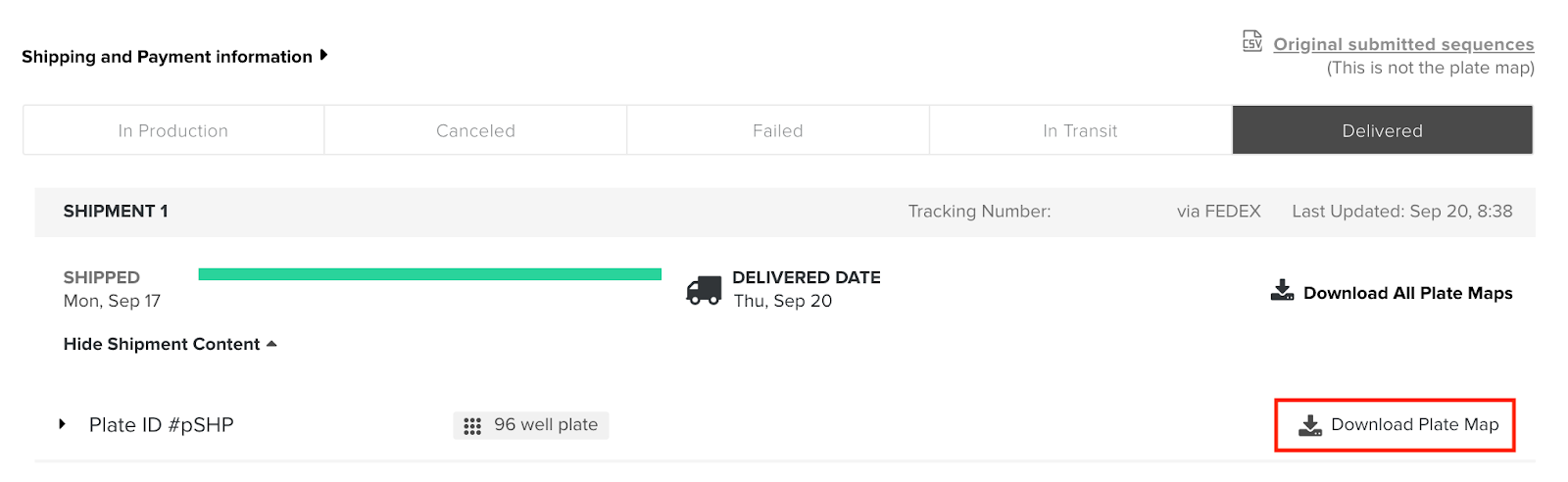
You can download plate map information for any order while logged in to your account.
From the main page, click on Order & Drafts. Then, click on Past Orders. All of your Twist orders will appear. Click on the order you’re interested in and on the Delivered tab, you will see a link to download your plate map.
Still have questions? Contact Us
How does Twist test the quality of the gene synthesis?
All of our Clonal Gene synthesis products are NGS sequence verified.
Gene Fragments are not NGS verified. With a low error rate for gene synthesis, we estimate that you will need to sequence approximately 3, 4, or 6 colonies for Gene Fragments of 600, 1200, or 1800 bps respectively to obtain a sequence perfect clone with 99% confidence.
Still have questions? Contact Us
How is processing different when my gene is delivered in a plate versus having it delivered in a tube?
There are no differences in regards to the manufacturing of your gene and there are no pros or cons regarding quality - it is merely preference. Some customers prefer tubes to plates because it meets their storage needs. Other customers prefer plates because they have a high throughput workflow. Orders with 10 or more genes will be charged an additional $50 flat fee if tubes are requested.
Still have questions? Contact Us
How much of my DNA is delivered?
For Gene Fragments, we guarantee a yield of 100-1000 ng per fragment.
For Clonal Genes, we have a variety of yield options:
- Microprep: 1 µg - 4 µg per clone
- Miniprep: 4 µg - 10 µg per clone
- Midiprep: 10 µg - 100 µg per clone
- Maxiprep: 100 µg - 1 mg per clone
Depending on your sequence (and vector for clonal genes), the yield may be lower. If the yield is abnormally low, your gene may fail due to yield. Please note that sequences that fail for this reason will still ship, but you will not be charged. Customized target yield for miniprep scale is also available.
Still have questions? Contact Us
How should I resuspend my genes?
Twist DNA products are dried down and shipped in either 96/384-well plates or 2 ml microcentrifuge tubes. Although double-stranded DNAs are stable under most standard storage conditions, we recommend the following to maintain high quality DNA:
- Upon receipt, briefly centrifuge tube or plate and resuspend the DNA in nuclease free Tris-EDTA (TE) buffer, pH 8.0 or 10 mM Tris-HCl, pH 8.0 to the desired concentration.
- We do not recommend resuspension in water.
- A concentration of at least 10 ng/ul is recommended for a stock solution, but optimal concentration will need to be determined based on your desired application.
- Prepare aliquots of the stock and separate working aliquots to limit the chances of contamination and reduce the number of freeze/thaw cycles.
- For long term storage, freeze DNA at -20° C for up to one year, or at -80° C for even longer storage.
Resuspension guideline can be found here.
Still have questions? Contact Us
I got my genes, but the yield says “NA”. What does that mean?
Clonal genes have a minimum guaranteed yield of 50 ng. In a few cases, after sequence verification by NGS, we are unable to meet this minimum yield; however, we will still ship all the material we are able to recover.
For these constructs, you will see "NA" for the yield. You can try to rescue the construct by transformation into bacteria (please contact Customer Support for more information). You will not be charged for constructs that do not meet minimum yield.
Still have questions? Contact Us
What is Animal Origin Free?
To ensure that the manufacturing process is free from transmissible bovine diseases, Twist offers purified DNA constructs produced using non animal origin materials throughout the cloning, transformation, scale up, and purification processes.
Still have questions? Contact Us
What is the difference between Twist's Clonal Genes and Gene Fragments?
Gene Fragments are assembled and then checked for size and purity by fragment analysis. They are not sequence-verified. Therefore, Gene Fragments are non-clonal (i.e. they are a mixture of perfect and non-perfect material). If you are planning to clone fragments, it is important that you screen more than one clone. Fragments can range in size from 300 to 5,000 bp in length.
Conversely, Clonal Genes are assembled and then cloned into either a custom vector or one of Twist's own catalog vectors. Clones are then NGS sequence verified to confirm that only the requested sequences are shipped and delivered. Clonal Genes can range in size from 300 to 5,000 bp in length.
Still have questions? Contact Us
What is the maximum size gene I can purchase?
Currently, the maximum size for a gene fragment (linear double-stranded DNA) is 5 kb. The maximum size for a clonal gene (a gene cloned into a vector) is 5 kb.
Still have questions? Contact Us
What is the minimum size gene I can purchase?
Currently, the minimum size for our gene synthesis product (gene fragment or clonal gene) is 300 bp.
Still have questions? Contact Us
What is the shelf life of Gene Fragments and Clonal Genes?
Twist Bioscience ships its DNA products dried down or resuspended in 2 mL microcentrifuge tubes, 96-well plates, or 384-well plates. Dried DNA is shipped at ambient temperature and resuspended DNA is shipped frozen.
Double-stranded DNA and single-stranded oligonucleotides are stable under most standard laboratory storage conditions. However, it is important to consider the following best practices to maintain the high quality of the DNA synthesized by Twist Bioscience.
- Twist recommends storing Dried DNA for the following durations based on storage condition.
- Room Temperature for 3 months.
- 4° C for 12 months.
- -20° C for 24 months.
- -80° C for long term storage.
- Resuspension Guidelines
- For resuspension, briefly centrifuge the tube or plate before opening and resuspend in nuclease free Tris-EDTA (TE) buffer, pH 8.0 or 10 mM Tris-HCl, pH 8.0 to the desired concentration.
- A concentration of at least 10 ng/μL is recommended for the stock dilution, but the optimal concentration will need to be determined based on your desired application.
- Prepare aliquots of the stock dilution and separate working aliquots to limit chances of contamination and to reduce the number of freeze/thaw cycles. Use working aliquots as soon as possible after preparation and minimize exposure to high temperatures.
- Resuspended DNA
- Resuspension is available for some products. Your DNA may arrive in one of the following buffers. We recommend briefly centrifuging the tube or plate before opening.
- Elution buffer (2 mM Tris-Cl, pH 8.5)
- TE buffer (10 mM Tris-Cl pH 8.0, 1 mM EDTA)
- TE Buffer low EDTA (10 mM Tris-Cl pH 8.0, 0.1 mM EDTA)
- Water
- We do not recommend long-term storage in water.
- Twist recommends storing Resuspended DNA for the following durations based on storage condition.
- Room Temperature for 3 months.
- 4° C for 12 months.
- -20° C for 24 months.
- -80° C for long term storage.
- Resuspension is available for some products. Your DNA may arrive in one of the following buffers. We recommend briefly centrifuging the tube or plate before opening.
Still have questions? Contact Us
What is the Target Yield option?
When ordering a cloned gene, users have an option at checkout to select an integer mass of DNA to be delivered as part of their plasmid prep. Mass is automatically measured and ensured for the user. If we don’t hit the required mass in a single prep, we perform additional preps until we hit the required mass.
Still have questions? Contact Us
What is the Turn Around Time (TAT) for gene synthesis?
For Gene Fragments with adapters, the turnaround time is 2 to 4 business days, and for Gene Fragments without adapters, the turnaround time is 4 to 8 business days.
For Clonal Genes, the turnaround time starts at 4 to 7 business days for Express and 10 business days for Standard.
Timeline for Clonal Genes is based on the time it takes to complete synthesis and cloning successfully. If a gene fails at any step, it goes into our recovery pipeline and may be delayed. Optional services (like higher yield requests) may add to turnaround time.
Still have questions? Contact Us
Where can I find an SDS for gene products?
We only have SDS documents for NGS products on our web page; for SDS documents for our Synthetic Biology products, please email us at customersupport@twistbioscience.com.
Still have questions? Contact Us