



 Genes
Genes
 Oligo Pools
 NGS
NGS
 Variant Libraries
 Antibodies
 IVDR Solutions







Twist Bioscience HQ
681 Gateway Blvd
South San Francisco, CA 94080
Gene Synthesis
General
There are no differences in regards to the manufacturing of your gene and there are no pros or cons regarding quality - it is merely preference. Some customers prefer tubes to plates because it meets their storage needs. Other customers prefer plates because they have a high throughput workflow. Orders with 10 or more genes will be charged an additional $50 flat fee if tubes are requested.
For Gene Fragments (either with or without adapters), you may wish to add your own restriction sites onto the ends of each fragment in order to easily clone the fragment into your vector of choice.
For Clonal Genes, simply submit the unique insert sequences that you would like us to clone into the vector backbone. We use a proprietary homology-based cloning method to assemble our clonal genes and we design and add the homologous overhang sequences for you - you do not need to consider our cloning strategy when designing your insert.
Please note that our Cloning vectors do not have restriction sites directly flanking the insert. This allows for complete flexibility of design so that you can append the desired restriction sites onto the flanks of your insert for use in your downstream workflow.
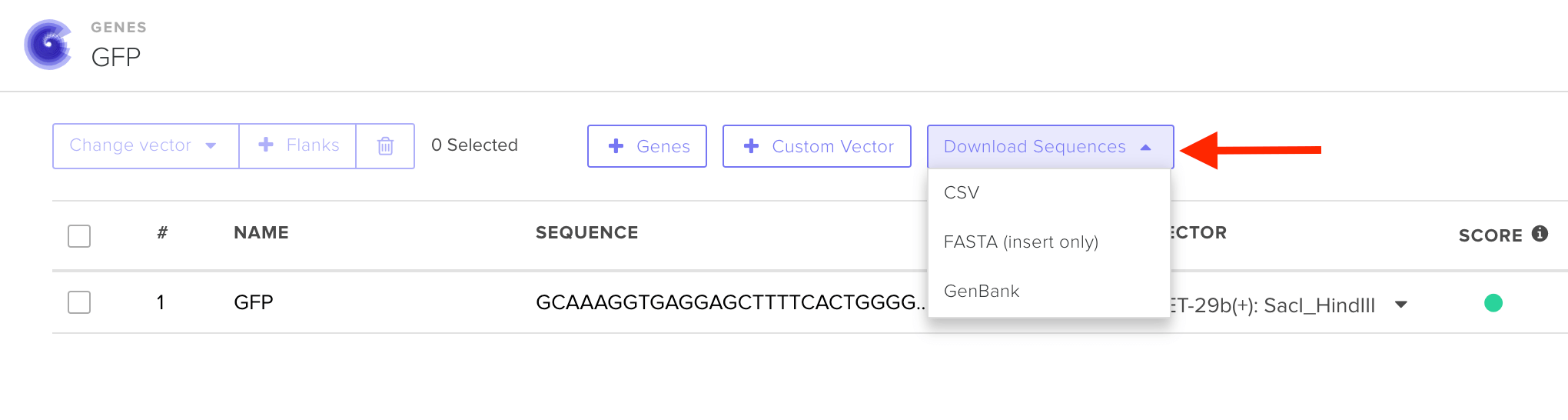
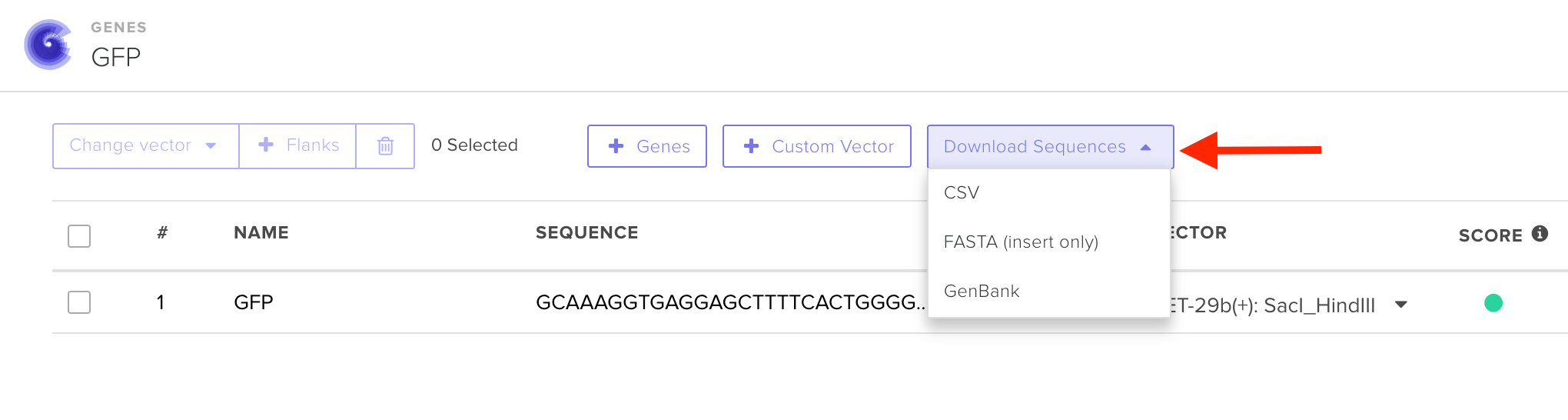
Our Expression vector insertion points are denoted by two restriction sites - these will be fully preserved directly flanking your insert in the final construct. We recommend that customers check the final construct sequences by clicking on the "Download sequences" button in the designer. Once an order has been submitted for manufacturing, it cannot be altered in any way.
All of our Clonal Gene synthesis products are NGS sequence verified.
Gene Fragments are not NGS verified. With a low error rate for gene synthesis, we estimate that you will need to sequence approximately 3, 4, or 6 colonies for Gene Fragments of 600, 1200, or 1800 bps respectively to obtain a sequence perfect clone with 99% confidence.
Twist Bioscience ships its DNA products dried down or resuspended in 2 mL microcentrifuge tubes, 96-well plates, or 384-well plates. Dried DNA is shipped at ambient temperature and resuspended DNA is shipped frozen.
- Twist recommends storing Dried DNA:
- Room temperature for 3 months
- 4° C for 12 months
- -20° C for 24 months
- -80° C for long term storage
- Resuspension Guidelines
- Briefly centrifuge the tube or plate before opening and resuspend in nuclease free Tris-EDTA (TE) buffer, pH 8.0 or 10 mM Tris-HCl, pH 8.0 to the desired concentration. A concentration of at least 10 ng/μL is recommended for the stock dilution. Prepare aliquots of the stock dilution and separate working aliquots to limit chances of contamination and to reduce the number of freeze/thaw cycles.
- Resuspended DNA may arrive in:
- Elution buffer (2 mM Tris-Cl, pH 8.5)
- TE buffer (10 mM Tris-Cl pH 8.0, 1 mM EDTA)
- TE Buffer low EDTA (10 mM Tris-Cl pH 8.0, 0.1 mM EDTA)
- Water
- We do not recommend long-term storage in water.
- Twist recommends storing Resuspended DNA:
- Room temperature for 3 months
- 4° C for 12 months
- -20° C for 24 months
- -80° C for long term storage
When ordering a cloned gene, users have an option at checkout to select an integer mass of DNA to be delivered as part of their plasmid prep. Mass is automatically measured and ensured for the user. If we don't hit the required mass in a single prep, we perform additional preps until we hit the required mass.
Currently, the maximum size for a gene fragment (linear double-stranded DNA) is 5 kb. The maximum size for a clonal gene (a gene cloned into a vector) is 7 kb.
Twist DNA products are dried down and shipped in either 96/384-well plates or 2 ml microcentrifuge tubes. Although double-stranded DNAs are stable under most standard storage conditions, we recommend the following to maintain high quality DNA:
- Upon receipt, briefly centrifuge tube or plate and resuspend the DNA in nuclease free Tris-EDTA (TE) buffer, pH 8.0 or 10 mM Tris-HCl, pH 8.0 to the desired concentration.
- We do not recommend resuspension in water.
- A concentration of at least 10 ng/ul is recommended for a stock solution, but optimal concentration will need to be determined based on your desired application.
- Prepare aliquots of the stock and separate working aliquots to limit the chances of contamination and reduce the number of freeze/thaw cycles.
- For long term storage, freeze DNA at -20° C for up to one year, or at -80° C for even longer storage.
Resuspension guideline can be found here.
Gene products are typically delivered as a dried-down product (unless otherwise specified).
Clonal Genes are delivered cloned into one Twist's catalog vectors or your own custom vector. Gene Fragments are delivered as linear, double stranded sequences (with or without flanking adapters).
We deliver the gene sequences in 96/384-well plates. For small orders (less than 10), the genes can be delivered in tubes at no additional cost. For orders with 10 or more genes, tube order requests are an additional $50 per order.
Twist Bioscience attests that the company adheres to all requirements in the U.S. Office of Science and Technology Policy (OSTP) Framework for Nucleic Acid Synthesis Screening.
Clonal genes have a minimum guaranteed yield of 1 ug. In a few cases, after sequence verification by NGS, we are unable to meet this minimum yield; however, we will still ship all the material we are able to recover.
For these constructs, you will see "NA" for the yield. You can try to rescue the construct by transformation into bacteria (please contact Customer Support for more information). You will not be charged for constructs that do not meet minimum yield.
- Gene Fragments (with or without adapters): 2-4 business days
- Clonal Genes:
- Low/Medium Complexity : 10 business days (standard shipping) 4-7 business days (express shipping).
- High Complexity 10 - 15 business days (Standard; Express not available)
To ensure that the manufacturing process is free from transmissible bovine diseases, Twist offers purified DNA constructs produced using non animal origin materials throughout the cloning, transformation, scale up, and purification processes.
We only have SDS documents for NGS products on our website. For SDS documents for our Synthetic Biology products, please email us at customersupport@twistbioscience.com.
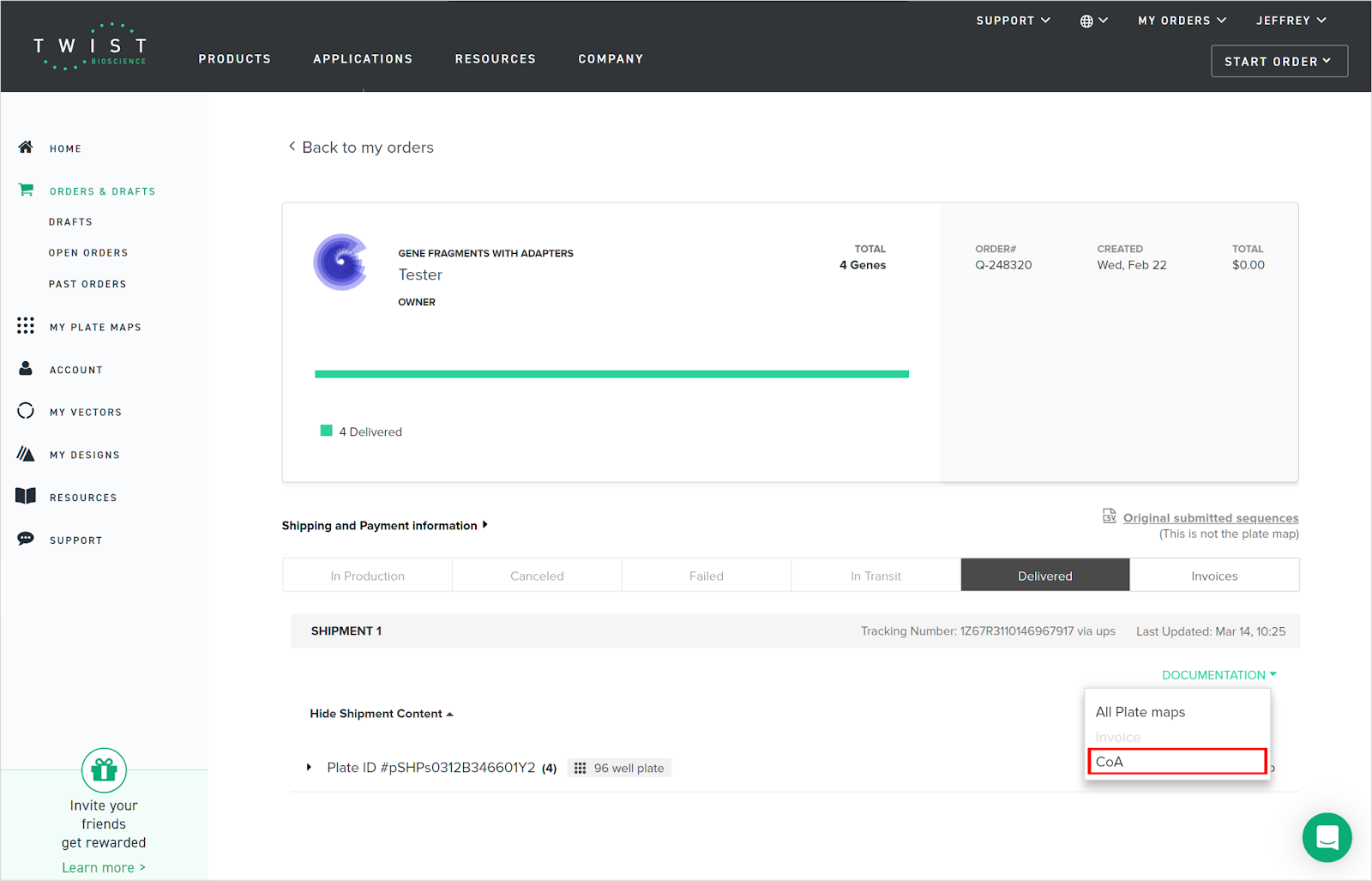
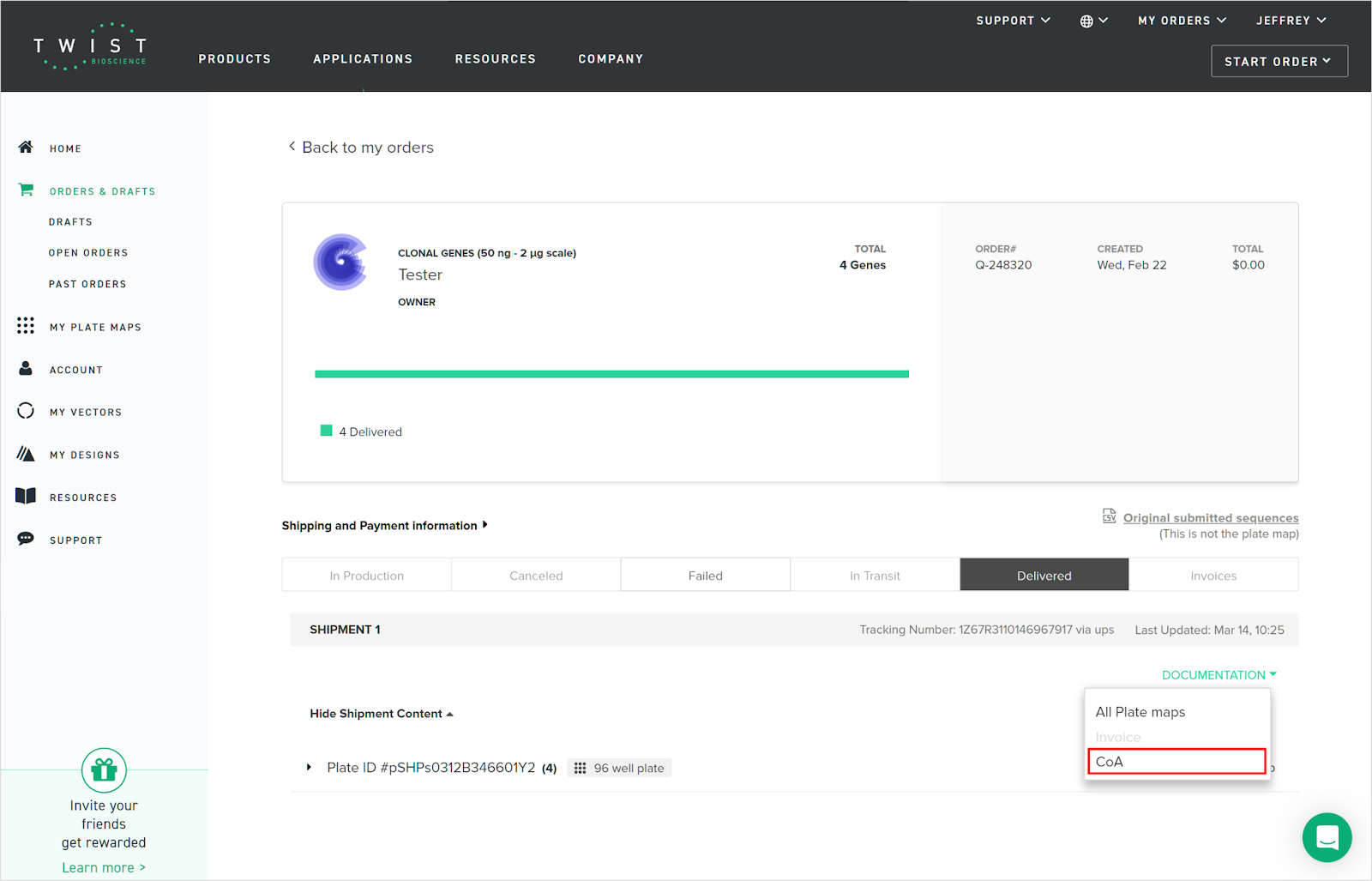
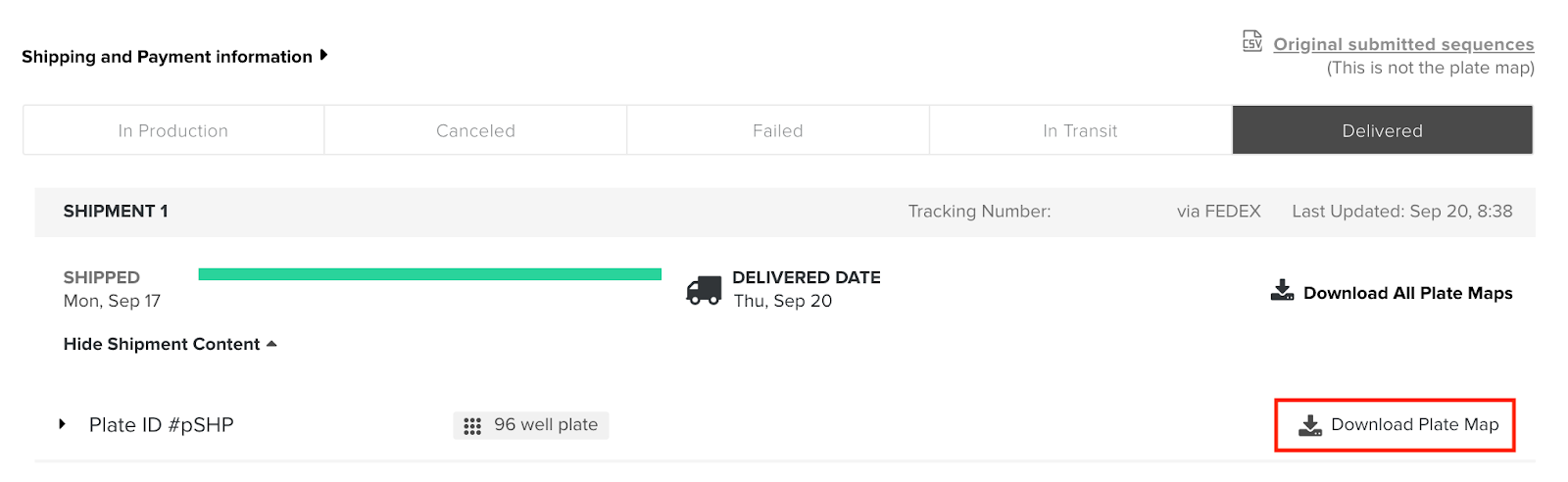
You can download plate map information for any order while logged in to your account.
From the main page, click on Order & Drafts. Then, click on Past Orders. All of your Twist orders will appear. Click on the order you’re interested in and on the Delivered tab, you will see a link to download your plate map.
Currently, the minimum size for our gene synthesis product (gene fragment or clonal gene) is 300 bp.
Gene Fragments are assembled and then checked for size and purity by fragment analysis. They are not sequence-verified. Therefore, Gene Fragments are non-clonal (i.e. they are a mixture of perfect and non-perfect material). If you are planning to clone fragments, it is important that you screen more than one clone. Fragments can range in size from 300 to 5,000 bp in length.
Conversely, Clonal Genes are assembled and then cloned into either a custom vector or one of Twist's own catalog vectors. Clones are then NGS sequence verified to confirm that only the requested sequences are shipped and delivered. Clonal Genes can range in size from 300 to 7,000 bp in length.
For Gene Fragments, we guarantee a yield of 100-1000 ng per fragment.
For Clonal Genes, we have a variety of yield options:
- Microprep: 1 µg - 4 µg per clone
- Miniprep: 4 µg - 10 µg per clone
- Midiprep: 10 µg - 100 µg per clone
- Maxiprep: 100 µg - 1 mg per clone
Depending on your sequence (and vector for clonal genes), the yield may be lower. If the yield is abnormally low, your gene may fail due to yield. Please note that sequences that fail for this reason will still ship, but you will not be charged. Customized target yield for miniprep scale is also available.
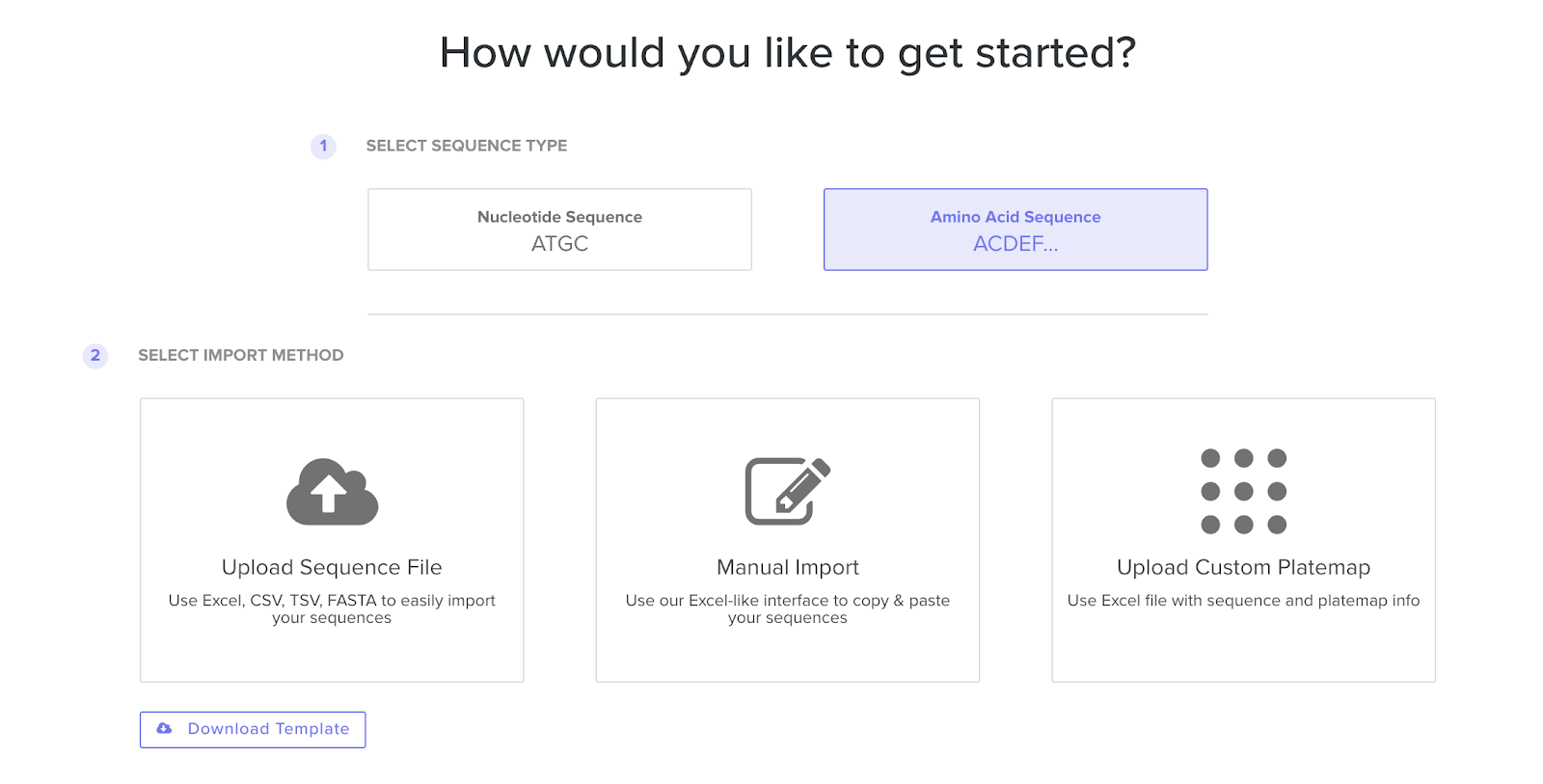
Our updated uploader is designed for maximum flexibility. You can upload an Excel template or a CSV file containing your sequence names and the sequences themselves.
Auto-Detection: The algorithm automatically detects if your sequences are in DNA or Amino Acid format.
Flexible Mapping: The system automatically identifies columns for Well, Plate, and Custom Plate Maps.
Post-Upload Editing: If your file doesn't contain location data, don't worry—you can specify the Well and Plate information directly in the interface after the file has been uploaded.
Gene Fragments
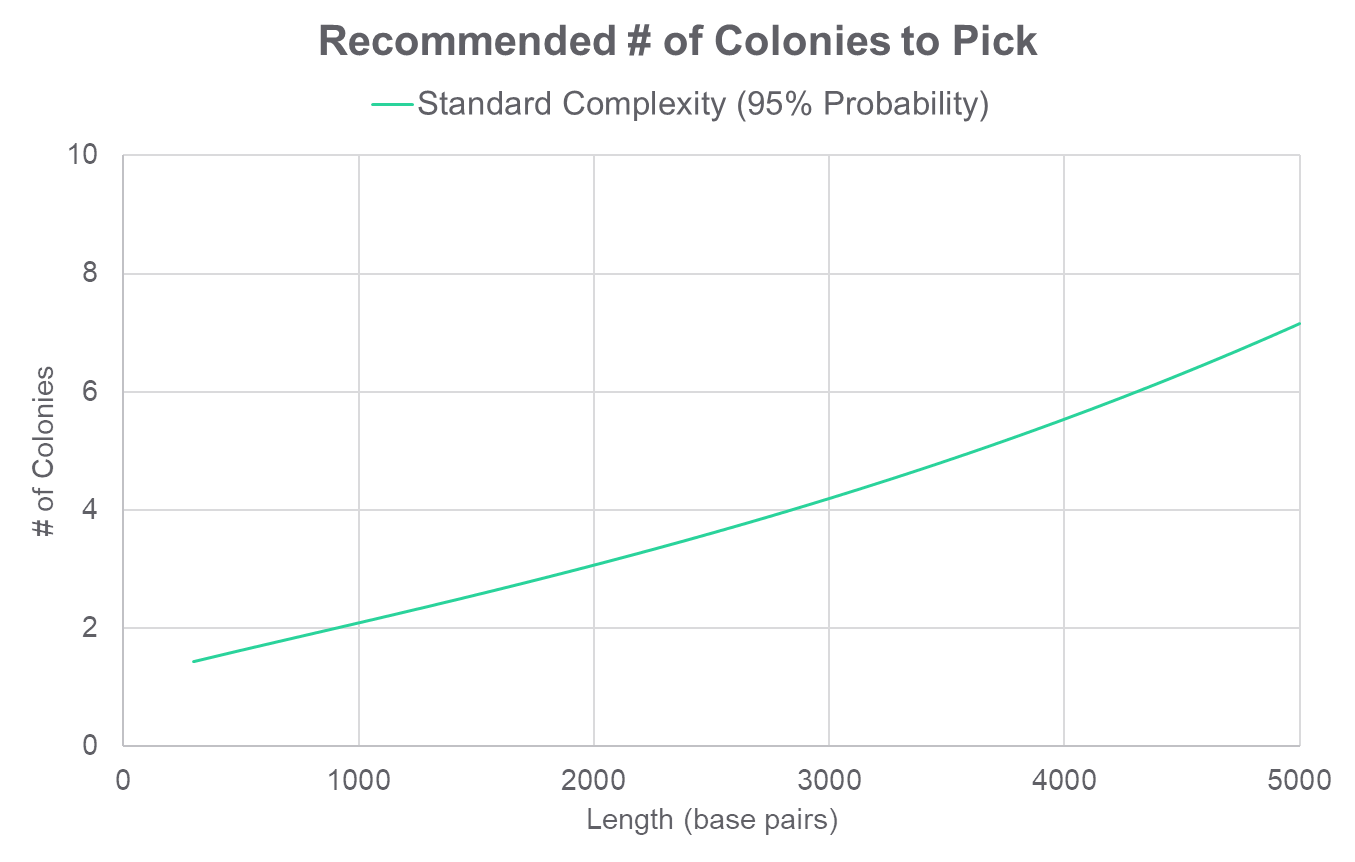
For standard complexity sequences and considering our error rate of 1 in 7500, selecting the recommended number of colonies, as shown in the graph, provides a 95% probability of finding a colony with the correct sequence.
Please note that this recommendation is a starting point. Various factors, such as vector type, sequence complexity, and sequence content, can affect colony growth. In some scenarios, selecting 2 to 3 times the recommended number of colonies may be necessary.
For Adapter-On Gene Fragments, universal adapters are synthesized onto the ends of each fragment. The adapters are 21-22 nucleotides in length. Fragments with these adapters are compatible with a number of assembly methods, namely Restriction Digestion/Ligation, Gateway, Golden Gate, and TOPO cloning.
The addition of restriction sites inside of the adapters can be used to remove adapters. TOPO cloning will work but will leave the adapters on.
ADAPTER SEQUENCES
- For orders received before August 9, 2021, the adapter sequences are as follows:
- 5' Adapter: GAAGTGCCATTCCGCCTGACCT
- 3' Adapter: AGGCTAGGTGGAGGCTCAGTG
- For orders received after August 9, 2021 to November 1, 2021, the adapter sequences are as follows:
- 5' Adapter: CCCCGTCACCTTTGGCTTATCAGT
- 3' Adapter: AGTGACATCTGGACGCTAAGACCG
- For orders received after November 2, 2021, the adapter sequences are as follows:
- 5' Adapter: CAATCCGCCCTCACTACAACCG
- 3' Adapter: CTACTCTGGCGTCGATGAGGGA
Adapters are short sequences added to each end of the insert as part of our synthesis process. Gene fragments without these adapters are also available during the checkout process.
If you have any questions about your order, please contact us at customersupport@twistbioscience.com.
Yes, gene fragments go through a bead-based clean up; however, short fragments can carry over in small quantities.
- For orders received before August 9, 2021, the adapter sequences are as follows:
- 5' Adapter: GAAGTGCCATTCCGCCTGACCT
- 3' Adapter: AGGCTAGGTGGAGGCTCAGTG
- 5' – GAAGTGCCATTCCGCCTGACCT – insert – AGGCTAGGTGGAGGCTCAGTG – 3'
- For orders received after August 9, 2021 to November 1, 2021, the adapter sequences are as follows:
- 5' Adapter: CCCCGTCACCTTTGGCTTATCAGT
- 3' Adapter: AGTGACATCTGGACGCTAAGACCG
- 5' - CCCCGTCACCTTTGGCTTATCAGT – insert – AGTGACATCTGGACGCTAAGACCG - 3'
- For orders received after November 2, 2021, the adapter sequences are as follows:
- 5' Adapter: CAATCCGCCCTCACTACAACCG
- 3' Adapter: CTACTCTGGCGTCGATGAGGGA;
- 5' - CAATCCGCCCTCACTACAACCG – insert – CTACTCTGGCGTCGATGAGGGA - 3'
Adapters are short sequences added to each end of the insert as part of our synthesis process. Gene fragments without these adapters are also available during the checkout process.
If you have any questions about your order, please contact us at customersupport@twistbioscience.com
You can use the following methods to clone gene fragments with adapters:
Restriction digestion/Ligation - place restriction sites inside of the Twist adapters for easy cloning
Type IIS or Golden Gate - place restriction sites inside of the Twist adapters for easy cloning; TOPO cloning (blunt-end) - the adapter sequences will be cloned in as well
Gateway cloning - add attB sites to the ends of your sequence
Certificates of Analysis (COA) are available for completed orders. You can find the COA for Gene Fragment products in your account by clicking here.
Clonal Genes
Yes, there is an additional charge of $10 per gene.
Twist can clone gene synthesis products of up to 7,000 bp into any of our catalog vectors. We also offer cloning into your own custom vector.
The only Twist-provided vector that contains a Kozak sequence is pTwist ENTR Kozak. All remaining Cloning, Expression, and antibody backbone vectors offered by Twist Bioscience DO NOT contain Kozak or signal peptide (leader) sequences. Twist recommends including a Kozak (GCCGCCACC or variant) along with a signal sequence when planning to express proteins in Mammalian expression systems.
No - at this time, Twist does not have vectors for expression in plants; however, we can onboard a custom vector as long as it meets our requirements.
Certificates of Analysis (COA) are available for completed orders. You can find the COA for Clonal Gene products in your account by clicking here.
Sequence Design
Synthesis issues are driven mainly by repetitive structures, extreme GC content, and homopolymers. We use a machine learning method to determine the chance of success. Therefore, most of the time, there is no single reason for the rejection of a sequence. Rather, complexity or rejection stem from a combination of features that push a sequence into a given bucket of complexity. The only hard rules are the following:
Avoid homopolymers >= 14bp
Do not include CcdB (Type II Toxin-antitoxin system)
Should you encounter an issue, we recommend removing or minimizing repeats, regions of extreme GC content, and homopolymers. We will highlight regions of concern if your sequence is complex, unbuildable, or contains sequences which conflict with our internal processes.
Our website will accept amino acid sequences and convert them to a DNA sequence for synthesis. At the upload sequences page, select the Amino Acid Sequence option.
Make sure your input only contains Amino Acid one-letter characters. We support only the standard 20 one-letter code characters.
A "*" at the end of your amino acid sequences marks a stop codon (we do not add stop codons automatically).
Based on the Codon Usage Table you choose, the most frequently used codons will be selected.
If you do not see your specific organism, contact customersupport@twistbioscience.com for help.
Note for Clonal Genes: Not all Twist expression vectors contain standard expression machinery upstream of the insertion point. We recommend double-checking the sequence of your final plasmid construct by clicking "Download Sequences" after selecting your desired vector.
After submitting your gene sequences on our website, they will be automatically scored for feasibility of assembly:
Standard: No errors have been found. Gene sequence found to be of "standard" overall complexity (e.g. length, GC content, homology, etc).
Complex: No errors have been found. Some sequence complexities (e.g. length, GC content, homology, etc) exist but we do not expect any problems synthesizing your gene. Rarely, sequences may experience increased turnaround time or risk of manufacturing failure.
Error: Gene sequence contains errors. Please click on the sequence to get more details on how to resolve them.
Not Accepted: The sequence contains elements that make it impossible for us to synthesize. Please see the detailed explanations provided with the error message or refer to the “Design Guidelines”.
About Scoring System
Our scoring system adopts a machine learning model which analyzes and combines multiple sequence parameters ( i.e. overall GC percent, maximum homopolymer length, maximum repeat length, sequence length, repeat density, etc.). This model was trained using our historical manufacturing data, and it provides a more precise estimation of production success for genes and antibody products
About ISSUE messages
Warnings: Are associated with the risk of failure, predicted by the machine learning model. A higher number of warnings is more likely to result in a “Not Accepted” score.
Errors: Are not associated with gene complexity, and they can be fixed by correcting the gene design
Customers have the option of ordering oligo pools, gene fragments, and clonal genes.
Oligonucleotides (linear single-stranded DNAs) in an oligo pool can range in size from 20 bp to 300 bp.
Gene fragments are linear double-stranded DNAs that can range in size between 300 bp and 5,000 bp in length.
Clonal genes are double-stranded DNAs that have been cloned into one of Twist’s vectors or a customer-provided custom vector. Clonal genes can range in size between 300 bp and 5,000 bp in length.
Express Service
Express Genes are Clonal Genes produced faster using Twist's Express service. The Express service reduces production time as follows without compromising quality at any stage.*
- 1 µg - 4 µg & 4 µg - 10 µg DNA Scale: Standard: 10 business days; Express: 4-7 business days
- 10 µg - 100 µg & 100 µg - 1mg DNA Scale: Standard: 13 business days; Express: 7-10 business days
Express is available for Low and Medium complexity sequences
*Terms and Conditions: Advertised turnaround time for Express Clonal Genes is 4-7 business days and is based on extensive production experience. Your production time may vary from sequence-to-sequence. International orders may require additional shipping time. Express Genes fee is based on the capacity of the chip at time of order submission and will fluctuate.
Ordering Clonal Genes with our Express service ensures that an order receives top priority at every production stage. With additional resources dedicated to our new tier of service, this prioritized approach allows us to expedite the production of Clonal Genes without compromising quality.
No, the advertised turnaround time is the amount of time it takes to manufacture Express Genes.
All Clonal Genes (Express & Standard) are shipped using overnight or priority service.
Typical shipping times by region are as follows:
- North America: 1-2 business days
- Europe: 2-3 business days
- Asia: 2-4 business days
- South America: 3-6 business days
Express Genes ordered with glycerol stocks and Express Genes at the 10 μg - 100 μg and 100 μg - 1 mg DNA Scales (i.e. resuspended DNA) are shipped on dry ice, which may add one business day to the overall turnaround time.
General considerations that may delay shipping and delivery include:
- Issues with payment methods
- Country-specific import requirements
- Biosafety sequence screening
No, new custom vectors will need to be onboarded prior to ordering Express Genes. New Custom Vector Onboarding will take approximately 2 weeks.
For more information on Custom Vector Onboarding, please see the link to our FAQs for additional information.
Express genes are available in the following DNA prep sizes: 1 μg - 4 μg, 4 μg - 10 μg, 10 μg - 100 μg and 100 μg - 1 mg.
Turnaround time increases with prep size and is as follows: 4-7 business days for 1 μg - 4 μg and 4 μg - 10 μg, and 7-10 business days for 10 μg - 100 μg and 100 μg - 1 mg.
The same shipment format options are available for Standard and Express genes.
Clonal Gene sequences scored as "Low" or "Medium" complexity are eligible for the Express service. The Twist Bioscience eCommerce platform will score all sequences once they are uploaded and flag which ones are eligible for the Express service.
We use a three-tier scoring system to determine the manufacturability and turnaround time of your genes:
- Low Complexity: Standard designs with predictable manufacturing and our fastest turnaround.
- Medium Complexity: Designs that require additional manufacturing precautions but do not require changes to your sequence.
- High Complexity: Highly intricate designs requiring specialized workflows and extended turnaround times.
Modify: This status appears if your sequence falls outside our complexity parameters, is too long/short, or contains non-standard characters.
Our algorithm flags sequences as High Complexity if they meet any of the following criteria:
- GC Content: Local GC content within a 50 bp window falls below 10% or exceeds 90%.
- Repeats: Direct repeats >200 bp; Short Tandem Repeats (STRs) >100 bp.
- Secondary Structures: Hairpin-forming repeats >100 bp.
- Homopolymers: Any single-nucleotide run (A, T, G, or C) >30 bp.
- Length: Any sequence between 300 bp and 7000 bp that triggers the above flags.
Note: For Medium and High complexity sequences, our website will now display specific warning flags to show you exactly which features are driving the complexity score.
The Express service is an upgraded service for Clonal Genes that provides a faster turnaround time than our Standard service.
Product Feature | Express | Standard |
Turnaround Time | 4 - 7 business days | 10 business days |
DNA Scale | 1 μg - 4 μg, 4 μg - 10 μg, 10 μg - 100 μg, 100 μg - 1 mg (turnaround for | |
Complexity | Low and Medium only | High, Medium or Low |
Size | 0.3 - 7.0 kb | |
Vectors | Catalog and Custom | |
Vector Antibiotics | AMP, KAN, CHL | AMP, KAN, BLS, CHL, SPE, TET, ZEO |
¹ Turnaround time for Express Gene DNA Scales 10 μg - 100 μg and 100 μg - 1 mg is 7 - 10 business days. | ||
High complexity sequences often require more production time to synthesize and clone, and therefore, will require additional manufacturing precautions and TAT speed.
Express Genes service employs dynamic pricing to ensure availability at all times and reliable on-time delivery, especially during high-demand periods. Whenever there's a change in pricing, it will be reflected on our eCommerce platform.
We continue to offer Clonal Genes produced with our Standard speed of service, which has a 10 business day turnaround time.
Contracted pricing will be reflected in the base price of each gene, and the Express service fee is added as a separate line item relative to that contracted base price.
Twist is committed to providing the best experience possible. In the event Express Genes are delivered late, the Express service fee will be discounted 100% and you will be invoiced at the Standard Clonal Gene price. Terms and conditions for the policy are here.
Additionally, we stand behind Express Genes with our Twist Satisfaction Policy. In the event that you are not satisfied with your Express Genes, please notify us within thirty (30) days of order placement.
Only "Low" and "Medium" complexity sequences are eligible for the Express service. If a gene sequence is grayed out under the Express Genes section, that means it is a "High" Complexity or needs to be modified (score appears as "Modify") sequence and will be marked as such in the eCommerce platform.
Yes, the maximum limit when configuring a project on eCommerce is 1152 Express Genes. If you plan on placing an order with more than 1152 Express Genes, please contact Customer Support for help submitting your order.
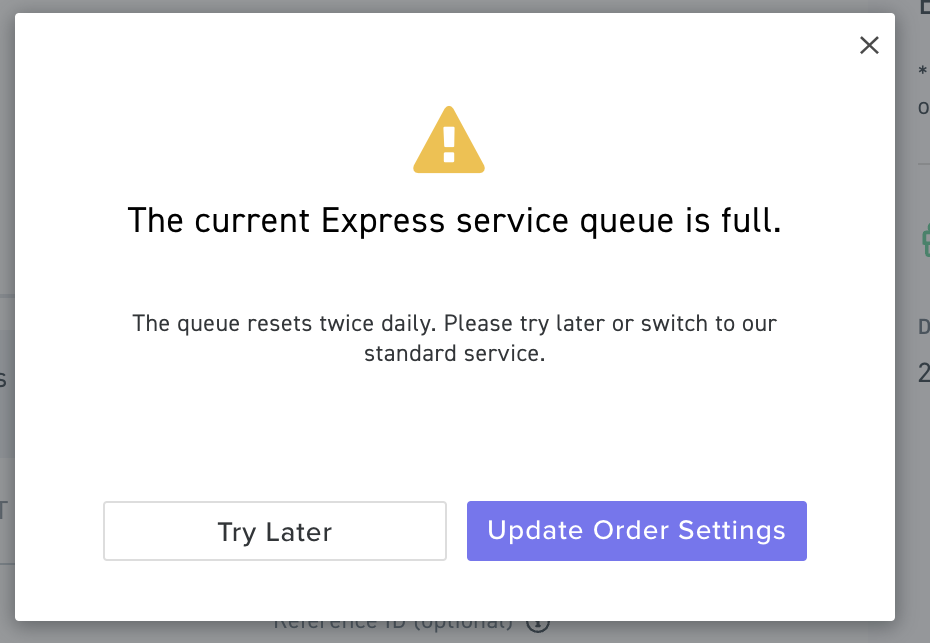
This indicates that we have reached maximum capacity for the current Express Genes run. Express Genes are run multiple times a day, please check back soon.
High complexity sequences often require more production time to synthesize and clone, and therefore, will require additional manufacturing precautions and TAT speed.
Codon Optimization
We have moved beyond simple codon frequency tables. Our new algorithm prioritizes biological expression by focusing on:
- mRNA Stability
- Secondary Structure
- Ribosome Processivity
We have decoupled manufacturability parameters from the core optimization to focus primarily on protein expression. However, if the algorithm cannot find a manufacturable solution, it will automatically attempt to fix localized regions of extreme complexity. We do this while minimizing any impact on the expression profile.
Important: While we optimize for the best possible DNA composition, please remember that protein expression is multifactorial; DNA sequence is just one of many variables influencing your final yield.
Currently, we are unable to synthesize genes that score as Impossible. There are several factors that cause our algorithm to score a gene Impossible and the specific parameters are unique to the gene sequence. Our algorithm is proprietary and was developed using machine learning. In addition to machine learning, our algorithm does take into consideration the following factors:
- %GC between 25-65%
- Max homopolymer length < 10
- Low homology
A unique combination of the above is a reflection of the specific gene sequence score of Impossible.
Twist supports over 150 organisms, including most frequently used organisms such as E. coli, human, CHO, mouse and yeast.
We have moved beyond simple codon frequency tables. Our new algorithm prioritizes biological expression by focusing on:
- mRNA Stability
- Secondary Structure
- Ribosome Processivity
We have decoupled manufacturability parameters from the core optimization to focus primarily on protein expression. However, if the algorithm cannot find a manufacturable solution, it will automatically attempt to fix localized regions of extreme complexity. We do this while minimizing any impact on the expression profile.
Important: While we optimize for the best possible DNA composition, please remember that protein expression is multifactorial; DNA sequence is just one of many variables influencing your final yield.
Still have questions? Contact us
Learn more about Gene Synthesis